 WhatsApp Us (24/7)
 +91 926 888 0303 (24/7)


To Book an Appointment
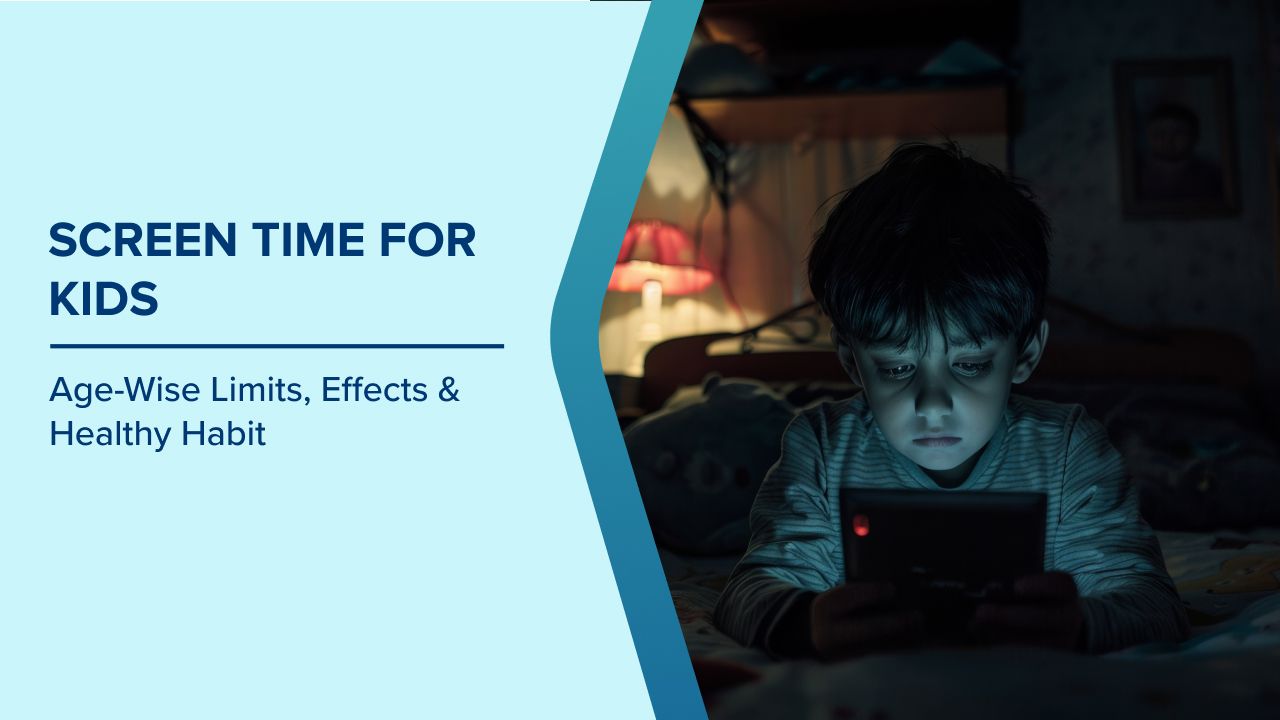
Call Us+91 926 888 0303Screen Time for Kids: Age-Wise Limits, Effects & Healthy Habits
By Dr. Manu Sharma in Neonatology , Paediatrics (Ped) , Paediatric (Ped) Intensive Care , Paediatric (Ped) Nephrology , Paediatric (Ped) Oncology
Sep 10 , 2026

There is no single screen-time limit that is right for every child. For younger children, clearer age-based limits can help, while for school-age children and teenagers, parents also need to consider whether screen use affects sleep, physical activity, schoolwork, family time and other parts of daily life. The right amount depends on a child's age, what they are doing on the screen, when they use it and what that screen time replaces.
The goal is not to eliminate screens, but to develop healthy screen time habits that leave enough room for sleep, play, movement, learning, family interaction and other activities important for healthy growth.
How Much Screen Time Should Children Have?
Screen time recommendations vary with age and developmental stage. Rather than focusing only on the number of minutes, parents should also consider the quality and purpose of screen use. Here is a practical age-wise guide:
Infants and Children Under 2
For babies and very young children, screen use should generally be avoided, apart from activities such as video calls with family.
For children between 18 and 24 months, if parents choose to introduce digital media, it is better to select high-quality, age-appropriate content and use it together with the child rather than allowing independent screen use.
At this age, real-world experiences are particularly important. Talking, singing, reading, crawling, walking, exploring and interactive play help children learn through direct interaction with the people and environment around them.
Toddlers and Preschool Children
For children aged two to five, screen use is generally best kept to around one hour or less of high-quality content per day, with parents encouraged to watch or engage with the child.
The quality of content matters too. Educational, age-appropriate and interactive content can be more meaningful than long periods of passive viewing. Parents can also ask:
- Is the content suitable for the child's age?
- Is the child watching alone or with an adult?
- Is screen use replacing active play?
- Is it affecting bedtime or mealtimes?
School-Age Children
For children aged six and above, there is no single number of hours that works equally well for every child.
Instead, parents can create consistent family rules that protect the essentials of a child's daily routine. Consider whether:
- Screen use is affecting homework.
- The child gets enough physical activity.
- Bedtime is being delayed.
- Screens are replacing outdoor play or family time.
- The child can stop using the device when asked.
A child who spends some time gaming or watching videos but continues to sleep well, stay active, complete schoolwork and participate in family life may have a healthier screen routine than a child who spends fewer hours on screens but struggles to maintain these activities.
Teenagers
For teenagers, setting one strict daily number can be difficult because screens are often used for schoolwork, communication, entertainment and social interaction. Instead, parents can focus on healthy boundaries and balance. Ask whether screen use is interfering with:
- Sleep
- School responsibilities
- Physical activity
- Family relationships
- Friendships
- Hobbies
- Emotional wellbeing
The aim is to help teenagers develop the ability to manage their own screen use responsibly as they become more independent.
Does All Screen Time Have the Same Effect?
No, screen time is not one single activity. A video call with a grandparent is different from watching videos for several hours. Completing schoolwork is different from scrolling through social media late at night. Playing an age-appropriate interactive game with a parent is different from continuously watching passive content. Screen use can include:
- Educational use: Online classes, homework and learning activities
- Social use: Video calls and age-appropriate communication
- Interactive use: Educational games, creative apps and supervised activities
- Entertainment: Television, videos, gaming and social media
- Passive viewing: Long periods of watching content without interaction
This does not mean that one type is automatically good and another is bad. The bigger question is whether the child's overall routine remains balanced.
Why Does Too Much Screen Time Matter?
The concern with excessive screen time in children is often less about the screen itself and more about what prolonged or poorly managed use may replace. When screens consistently take up a large part of the day, children may have less time for:
- Physical activity
- Outdoor play
- Reading
- Creative activities
- Talking with parents
- Playing with other children
- Family meals and conversations
- Adequate sleep
This is why screen time and child development should not be viewed as a simple cause-and-effect relationship.
A child's complete daily routine matters. Screen use becomes more concerning when it consistently pushes aside activities that support physical, emotional, social and cognitive development.
Can Too Much Screen Time Affect Children's Sleep?
Sleep is one of the areas parents should pay particular attention to when managing screen use.
Screens close to bedtime can make it harder for children to wind down. Games, videos, social media, notifications and other stimulating content can also encourage children to stay awake longer than planned. Parents can support better screen time and sleep habits by:
- Creating a predictable bedtime routine
- Keeping phones and tablets outside the bedroom at night
- Switching screens off at least an hour before bedtime
- Using the final part of the evening for reading, talking or quiet activities
- Turning off unnecessary notifications
The goal is not simply to remove a device. It is to create a calmer transition between daytime activity and sleep.
Can Screen Time Affect Children's Eyes?
Long periods of screen use can contribute to digital eye strain. Children may experience tired or sore eyes, dryness, irritation, blurred vision or headaches, particularly after spending a long time focusing on a nearby screen.
Children may also blink less when concentrating on a screen, which can contribute to dry or uncomfortable eyes. Simple habits can help:
- Encourage regular breaks from close-up screen work.
- Try the 20-20-20 rule: every 20 minutes, look at something about 20 feet away for 20 seconds.
- Encourage children to blink regularly.
- Keep screens at a comfortable distance.
- Position screens appropriately to reduce neck and eye strain.
- Reduce glare and ensure comfortable lighting.
- Encourage regular outdoor time.
Ordinary screen use should not automatically be viewed as causing permanent eye damage. However, persistent blurred vision, eye pain, frequent headaches or other ongoing visual concerns should be evaluated by an eye specialist.
Does Screen Time Affect Child Development?
Children learn through far more than screens. Talking to parents, playing with others, reading, exploring outdoors and participating in hands-on activities all contribute to learning and development.
For young children especially, excessive or poorly managed screen use can reduce opportunities for:
- Conversation
- Interactive play
- Physical movement
- Exploration
- Creative activities
- Social interaction
- Learning with caregivers
This does not mean that every child who enjoys screen time will experience developmental difficulties. Instead, parents should consider whether screens are crowding out experiences children need for healthy growth and development.
Signs Your Child May Be Spending Too Much Time on Screens
There is no single behaviour that automatically means a child has a screen-use problem. However, certain patterns may suggest that the family's screen habits need to be reassessed. Parents can look out for:
- Difficulty stopping screen use even after agreed limits
- Frequent arguments whenever screen time ends
- Screen use interfering with bedtime or sleep
- Less interest in outdoor play or hobbies
- Reduced family interaction
- Skipping meals or activities to continue using a device
- Difficulty completing homework or daily routines
- Turning to screens whenever bored or upset
- Screens becoming the main way the child relaxes
One or two of these behaviours do not necessarily mean there is a serious problem. What matters is whether the pattern is persistent and begins interfering with everyday life.
How Can Parents Reduce Screen Time Without Constant Conflict?
Reducing screen time does not have to mean suddenly taking away every device. In many families, gradual and predictable changes are easier for children to accept.
Set Consistent Screen-Time Rules
Children are more likely to understand boundaries when the rules are predictable. Decide when, where and how screens can be used rather than negotiating from scratch every day. Family rules can cover:
- Meals
- Homework
- Bedtime
- Gaming
- Phone use
- Television
- Social media
The rules can also change as children grow older and become more responsible with their devices.
Create Screen-Free Times
Good starting points can include:
- Family meals
- Before bedtime
- Family conversations
- Certain homework periods when entertainment media becomes distracting
Screen-free periods help children understand that devices are one part of daily life, rather than something that needs to be available all the time.
Offer Alternatives, Not Just Restrictions
It is easier to reduce screen use when children have something enjoyable to do instead. Depending on their age and interests, alternatives could include:
- Outdoor play
- Sports
- Reading
- Drawing
- Music
- Board games
- Puzzles
- Hobbies
- Family activities
Instead of simply saying, "You cannot use the phone," parents can offer another option: "Would you like to go for a walk?" or "Let's play a game together."
Be a Role Model
Children notice how adults use their devices. If parents regularly check their phones during meals or conversations, children may find screen restrictions harder to understand.
Putting devices away during family time can make healthy screen habits a shared family practice, rather than a rule imposed only on children.
Use Parental Controls Wisely
Parental controls can help parents manage content, notifications and time limits, particularly for younger children.
However, technology should not replace communication. Children also need to understand why certain boundaries exist and gradually learn how to manage their own digital habits.
What Is More Important Than Counting Minutes?
For many families, the better question is not simply: "How many hours of screen time did my child have today?" Instead, look at the whole day. Ask whether your child is getting enough:
- Sleep
- Physical activity
- School and learning time
- Outdoor play
- Family interaction
- Meals without screens
- Hobbies and creative activities
- Social interaction
If screens fit into this routine without consistently displacing these activities, the overall pattern may be healthier. The goal is balance, not perfection.
When Should Parents Talk to a Doctor?
Parents can consider speaking with a paediatrician if screen use is accompanied by concerns such as:
- Persistent sleep problems
- Significant or ongoing behavioural changes
- Developmental concerns
- Persistent headaches or eye discomfort
- Difficulty seeing clearly
- Problems with school performance
- Significant difficulty controlling screen use
A paediatrician can help determine whether the concern may be related to screen habits or whether another issue needs attention. For persistent visual symptoms, an eye specialist may be appropriate.
The aim is not to medicalise normal childhood behaviour, but to seek professional guidance when screen use is affecting a child's wellbeing or when symptoms persist.
Conclusion
So, how much screen time is too much for kids? The answer depends on more than the clock.
For young children, age-appropriate limits are important. As children grow, families can move towards personalised rules that consider schoolwork, entertainment, communication, sleep, physical activity and social interaction.
The goal is not to make childhood completely screen-free. It is to make sure screens have a place in a child's life, rather than taking the place of childhood itself.
With consistent boundaries, age-appropriate content, screen-free family time and plenty of opportunities to play, move, sleep and connect, parents can help children develop healthier digital habits without turning every screen into a source of conflict.
Frequently Asked Questions
How many hours of screen time should a 5-year-old have?
For a five-year-old, screen use is generally best limited to around one hour or less of high-quality content per day, with parents encouraged to be involved. Less screen time is preferable when it starts replacing active play, sleep or family interaction.
Is two hours of screen time too much for a child?
It depends on the child's age and what the screen time involves. For a preschool child, two hours would generally be more than recommended. For an older child, parents should consider whether those two hours interfere with sleep, physical activity, schoolwork or family life.
Should children use phones before bedtime?
It is better to avoid phones and other screens close to bedtime. Notifications, stimulating content and continued engagement with a device can make it harder for children and teenagers to settle down for sleep.
How do I reduce my child's screen time?
Start with predictable rules, screen-free periods and enjoyable alternatives. Gradually reducing screen use and involving children in age-appropriate family rules can make the transition easier.
What happens if a child spends too much time on a phone?
The concern is usually what prolonged phone use may replace. If it consistently reduces sleep, physical activity, family interaction, school responsibilities or other important activities, it may be time to reassess the child's screen habits.
Should parents completely ban screen time?
A complete ban is not necessary for most families. A better approach is to establish age-appropriate boundaries, encourage healthy digital habits and ensure screen use does not consistently interfere with sleep, movement, learning and relationships.
Written and Verified by:

Related Blogs


Blogs by Doctor


Most read Blogs


Related Blogs
Blogs by Doctor
Most read Blogs