 WhatsApp Us (24/7)
 +91 926 888 0303 (24/7)


To Book an Appointment
Call Us+91 926 888 0303Robotic Surgery for Throat Cancer: Benefits & Recovery
By Dr. Nitin Leekha in Surgical Oncology , Cancer Care / Oncology , Uro-Oncology , Breast Cancer , Thoracic Oncology , Gynecologic Oncology , Head & Neck Oncology , Robotic Surgery
Aug 03 , 2026

A diagnosis of throat cancer often brings concerns about both treatment and its impact on everyday functions such as speaking, swallowing, and breathing. While surgery has long been an important treatment option, advances in technology have made it possible to remove certain throat cancers using minimally invasive techniques.
One such approach is robotic surgery for throat cancer, which allows surgeons to operate through the mouth without making large external incisions in carefully selected patients.
What Is Robotic Surgery for Throat Cancer?
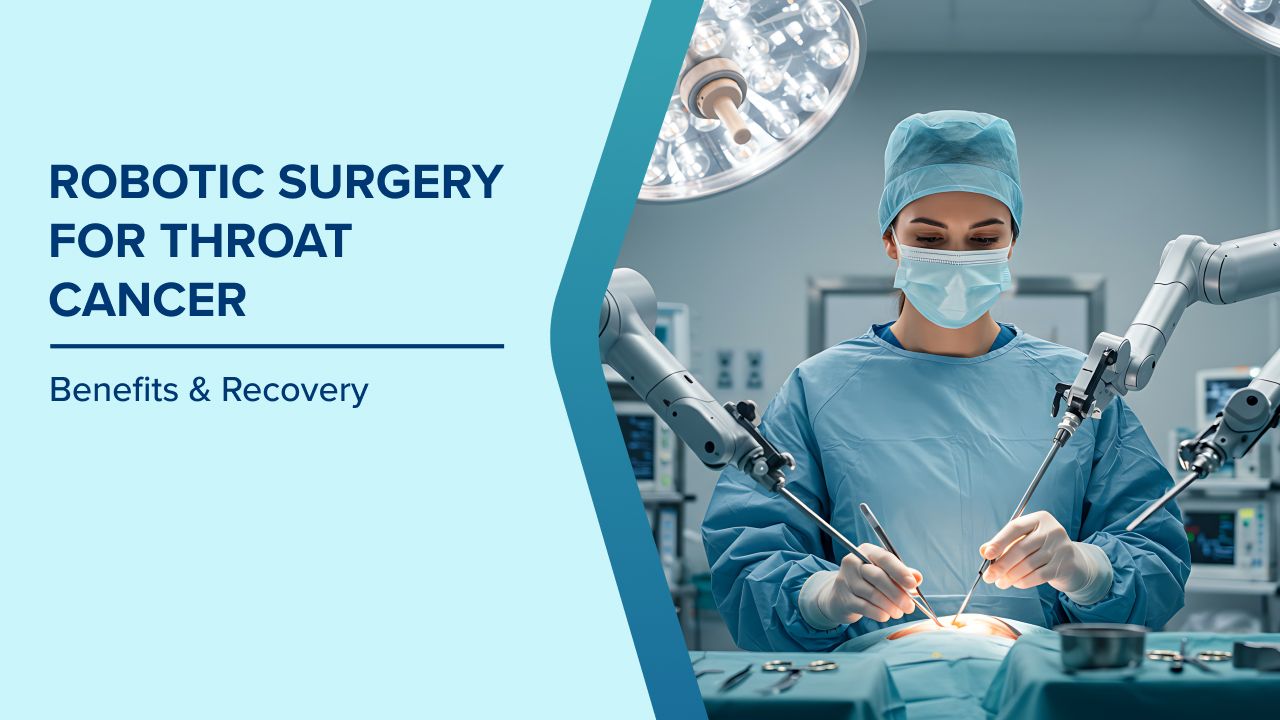
Robotic surgery is a minimally invasive surgical technique in which the surgeon controls robotic arms equipped with specialised instruments and a high-definition camera. The robotic system does not perform the operation independently. Instead, it translates the surgeon's hand movements into precise, controlled movements inside the body.
For many throat cancers, the procedure is performed through the mouth, avoiding external cuts in the neck. This technique is commonly known as transoral robotic surgery (TORS).
The enhanced visualisation and precision offered by robotic technology help surgeons remove cancer while preserving as much healthy tissue as possible.
Which Types of Throat Cancer Can Be Treated with Robotic Surgery?
Not every throat cancer can be treated using robotic surgery. Whether this approach is suitable depends on the location, size, and stage of the tumour, as well as the patient's overall health.
Robotic surgery may be considered for selected cancers involving:
- The tonsils
- The base of the tongue
- The oropharynx
- Certain areas of the voice box (larynx)
- Selected tumours of the pharynx
A multidisciplinary team carefully evaluates each case to determine the most appropriate treatment approach.
Who May Be a Suitable Candidate?
Your doctor may recommend robotic surgery if:
- The tumour can be safely reached through the mouth.
- The cancer is localised and has not extensively spread into surrounding structures.
- Surgery offers a good chance of completely removing the tumour.
- Your general health allows you to undergo anaesthesia and surgery.
Patients with large or advanced tumours may require a different surgical approach or a combination of surgery, radiotherapy, and chemotherapy.
Benefits of Robotic Surgery for Throat Cancer
One of the major advantages of robotic surgery is that it provides access to difficult-to-reach areas of the throat while minimising damage to nearby healthy tissues.
Some potential benefits include:
No Large External Incisions
Since the procedure is usually performed through the mouth, there are often no visible scars on the neck.
Greater Surgical Precision
The robotic instruments can perform delicate movements within confined spaces, helping surgeons remove cancer accurately while protecting nearby nerves and muscles.
Better Visualisation
A magnified, three-dimensional view allows the surgical team to clearly identify the tumour and surrounding structures during the procedure.
Reduced Blood Loss
The precision of robotic surgery may help minimise bleeding during the operation.
Shorter Hospital Stay
Many patients recover more quickly than they would after conventional open surgery and may be able to return home sooner, depending on the extent of the procedure.
Faster Recovery of Swallowing and Speech
Because healthy tissues are preserved whenever possible, many patients regain swallowing and speech function earlier than with more extensive open procedures.
How Is Robotic Surgery Performed?
Before surgery, you will undergo a detailed evaluation, which may include imaging scans, endoscopy, blood tests, and an assessment of your general fitness for surgery.
On the day of the procedure:
- General anaesthesia is administered.
- A mouth retractor gently keeps the mouth open.
- Miniature robotic instruments and a high-definition camera are introduced through the mouth.
- The surgeon sits at a nearby console and controls the robotic system.
- The tumour is carefully removed while preserving surrounding healthy tissue whenever possible.
- If required, lymph nodes in the neck may also be removed through a separate procedure.
Once the operation is complete, the instruments are removed, and the patient is transferred to the recovery area for monitoring.
What Happens After Surgery?
Recovery varies depending on the extent of surgery and whether additional procedures were performed.
Immediately after surgery, the healthcare team monitors:
- Breathing
- Swallowing
- Pain control
- Fluid intake
- Signs of bleeding or infection
Some patients can begin drinking liquids within a short period, while others may temporarily require a feeding tube until swallowing improves.
Your care team, including speech and swallowing specialists, will guide your recovery.
Recovery After Robotic Surgery for Throat Cancer
Recovery is usually gradual, with improvements occurring over several weeks.
During recovery, you may experience:
- Mild throat pain
- Temporary difficulty swallowing
- Hoarseness or changes in voice
- Fatigue
- Mild swelling
To support healing, your doctor may recommend:
- Eating soft foods initially
- Drinking enough fluids
- Taking prescribed medications as directed
- Performing swallowing exercises if advised
- Avoiding smoking and alcohol during recovery
- Attending all follow-up appointments
Recovery timelines vary, and some patients may recover faster than others, depending on the complexity of surgery.
Possible Risk Factors
Like all surgical procedures, robotic surgery carries some risks, although serious complications are uncommon.
- Bleeding
- Infection
- Temporary swallowing difficulties
- Voice changes
- Airway swelling
- Difficulty eating for a period after surgery
- Need for additional treatment if cancer cells remain
Your surgical team discusses these risks before the procedure and explains how they are managed.
Life After Robotic Surgery
Many people gradually return to their normal routines after recovering from robotic surgery. Regular follow-up visits remain an essential part of long-term care to monitor healing and detect any signs of recurrence.
Patients are often encouraged to:
- Maintain a nutritious diet
- Stay physically active as advised
- Continue speech or swallowing therapy if required
- Avoid tobacco products
- Limit alcohol consumption
- Report any new or persistent symptoms promptly
When Should You Contact Your Doctor During Recovery?
While mild discomfort is expected, you should contact your healthcare team if you develop:
- Heavy bleeding from the mouth
- Difficulty breathing
- High fever
- Severe pain that is not controlled with medication
- Increasing difficulty swallowing
- Persistent vomiting or inability to drink fluids
Prompt medical attention helps address complications before they become more serious.
Conclusion
Robotic surgery has expanded the treatment options available for selected patients with throat cancer. By allowing surgeons to access tumours through the mouth with greater precision, it can help preserve important functions such as speaking and swallowing while avoiding large external incisions. Although it is not suitable for every patient, careful evaluation by a multidisciplinary team can determine whether this minimally invasive approach is appropriate. Understanding the procedure, recovery process, and follow-up care enables patients and their families to approach treatment with greater confidence.
Frequently Asked Questions
1. Does robotic surgery completely replace conventional throat cancer surgery?
No. Robotic surgery is suitable only for selected tumours. Some patients may still require conventional open surgery depending on the location and stage of the cancer.
2. Will I need a tracheostomy after robotic throat surgery?
Most patients do not require a tracheostomy. In selected cases, a temporary breathing tube may be needed depending on the complexity of the surgery.
3. How soon can I return to work after robotic surgery?
Recovery varies between individuals and depends on the type of work you do. Your surgeon will advise when it is safe to resume normal activities.
4. Can robotic surgery affect my ability to eat permanently?
Most patients gradually regain swallowing function with recovery. Some may benefit from temporary dietary modifications or swallowing therapy during healing.
5. Does robotic surgery lower the chance of cancer returning?
The risk of recurrence depends on several factors, including the cancer stage, tumour characteristics, and whether additional treatment is required. Regular follow-up remains essential after surgery.
Written and Verified by:

Related Blogs

Dr. S. VEDA PADMA PRIYA In Surgical Oncology , Cancer Care / Oncology
May 16 , 2016 | 2 min read

Dr. Kanika Batra Modi In Surgical Oncology , Cancer Care / Oncology
May 26 , 2016 | 4 min read
Blogs by Doctor

Robotic Thyroidectomy, RABIT procedure: Pioneering Precision in Thyroid Surgery
Dr. Nitin Leekha In Cancer Care / Oncology
Aug 18 , 2023 | 1 min read

Cancer Screening & Early Detection: A Guide to World Cancer Day
Dr. Nitin Leekha In Cancer Care / Oncology
Feb 27 , 2024 | 2 min read
Most read Blogs


Related Blogs
Dr. S. VEDA PADMA PRIYA In Surgical Oncology , Cancer Care / Oncology
May 16 , 2016 | 2 min read
Dr. Kanika Batra Modi In Surgical Oncology , Cancer Care / Oncology
May 26 , 2016 | 4 min read
Blogs by Doctor
Robotic Thyroidectomy, RABIT procedure: Pioneering Precision in Thyroid Surgery
Dr. Nitin Leekha In Cancer Care / Oncology
Aug 18 , 2023 | 1 min read
Cancer Screening & Early Detection: A Guide to World Cancer Day
Dr. Nitin Leekha In Cancer Care / Oncology
Feb 27 , 2024 | 2 min read
Most read Blogs