 WhatsApp Us (24/7)
 +91 926 888 0303 (24/7)


Organ and Tissue Donation
You can help in Increasing organ donation by
Becoming an organ donor, and talking to your family about your decision of saving lives of others. Promoting donation by motivating people at work place, in your community, at your place of worship, and in your civic organisations.
Be an organ donor, be a life saver
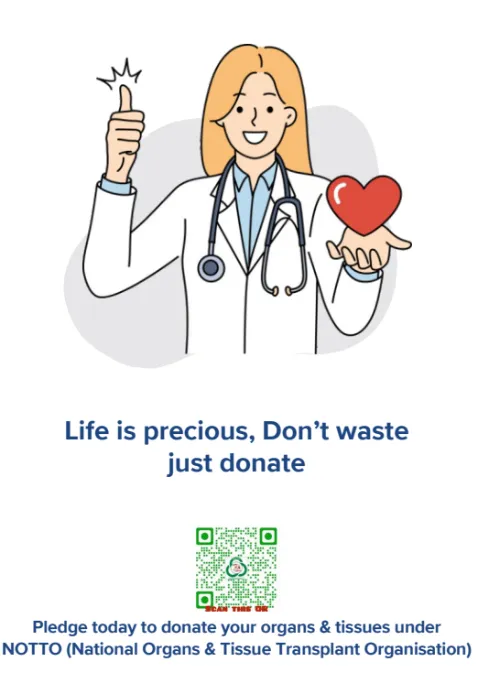
Pledge to donate your organs & tissues. Share your wish of donation with your family as their consent will always be required before retrieving the organs/tissues at the time of unfortunate event of death.
Body donation & organ donation
Body donation is as the act of giving one's body after death for medical education & research and is covered by the anatomy Act 1949. The donated bodies remain a principal teaching tool for anatomists, medical educators teaching gross anatomy and to carry out research. People pledge to donate their bodies during their life and communicate their wish to their family members.
Organ and tissue donation is meant for therapeutic purposes only and not for education or research purposes. After retrieving organs/tissues the bodies of such noble donors are returned to their families with utmost dignity for performing last rites.
Organ donation-at hospital or home?
Organ donation is only possible when the patient dies in the I.C.U. and is declared brain stem dead. No vital organs can be retrieved if the death occurs at home. However, tissues like cornea (eyes) & skin can be retrieved within a specified time limit, even if the individual dies at home.
No disfigurement after organ donation
The organs are removed carefully by taking the donor to the operation theater and there is no disfigurement. There is a cut on the body which is sutured just like any surgery performedon living persons.
Compensation or payment
Any kind of compensation or payment for donation of organs is not permissible under the THOTA 1994. However, the family is not charged for any procedure after the consent for organ donation is given.
Body donation after organ & tissue donation
Usually bodies are not accepted for teaching or research purposes after retrieval of organs/tissues or if there has been a post-mortem examination. However, if only the corneas are donated, a body can be left for research.
Organ donation
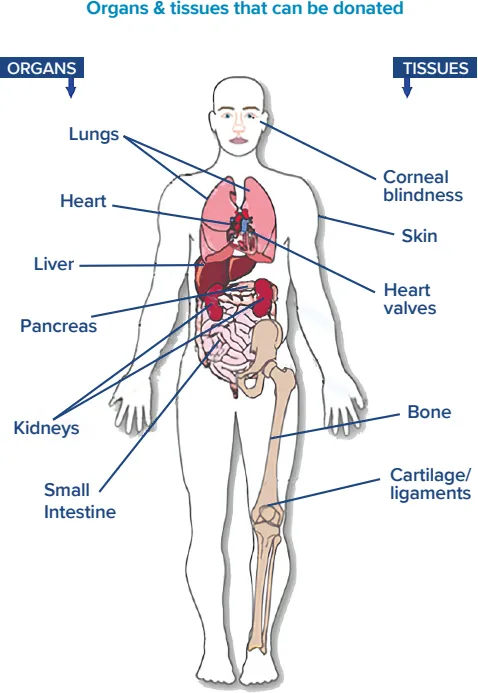
Organ donation is a noble act, which gives an opportunity to save lives after death. An organ is a part of the body that performs a specific function like heart, lungs, kidney, liver, pancreas & intestine, etc. Many patients suffer from end stage disease of various organs; organ donation is the only hope for them. The donated organs are transplanted into these patients for therapeutic purposes.
Tissue donation
Tissue is a group of cells that performs a particular function in the human body, for example cornea (eye), bones, skin, heart valves, blood vessels, nerves and tendon etc. Transplantation of different type of tissues can improve quality of life of many recipients.
Different types of organ donation
Living organ donation: a person, not less then 18 years of age, during his life, can voluntarily authorize the removal of organs for therapeutic purposes within the legal framework of the country.
He/she can donate one kidney (the other kidney is capable of maintaining the body function adequately for the donor), a part of the liver (the segments of liver will regenerate after a period of time in both recipient and donor), and a portion of the pancreas (half of the pancreas is adequate for sustaining pancreatic functions).
Types of living organ donation are:
- Near related donors
- Other than near related donors
- Swap donors
- Deceased organ donation: a person, regardless of age can donate multiple organs/tissues and give life to many patients after brain-stem/cardiac death. Consent of near relative or a person in lawful possession of the dead body is required. If the deceased donor is under the age of 18 years, then the consent is required from one of the parents or any near relative authorized by the parents. Medical suitability for donation is determined at the time of unfortunate event of death.
Is it possible to receive organs from a friend or other than near relative?
As per the transplantation of human organs and tissues act (THOTA), 1994, any living person other than near relative can also donate organ for the reason of affection and attachment towards recipient or for any other special reason. Such cases have to be approved by the authorization committee of the hospital, where the transplant is going to take place. Approval of authorization committee is mandatory in all, other than cases those involving relatives.
If such authorization committee is not existing in the hospital then it can be approved by the respective district or state level authorization committee.
Transplantation
Transplantation is the act of surgical removal of an organ from one person and placing it into another person. Transplantation is needed when the recipient's organ has failed or has been damaged due to illness or injury
End stage diseases that can be treated by organ transplantation
Diseases | Organs |
Heart failure Heart | Heart |
Terminal lung illnesses Terminal lung illnesses | Terminal lung illnesses |
Kidney failure Kidney | Kidney |
Liver failure Liver | Liver |
Diabetes Pancreas | Pancreas |
Corneal blindness Eyes | Eyes |
Heart valvular disease Heart valve | Heart valve |
Severe burns Skin | Skin |
How quickly donated organs should be transplanted
Healthy organs should be transplanted as soon as possible.
Different organs can be transplanted within different time frames as mentioned below:
Heart 4-6 Hours | 4-6 Hours |
Lungs 4-8 Hours | 4-8 Hours |
Intestine 6-10 Hours | 6-10 Hours |
Liver 12-15 Hours | 12-15 Hours |
Pancreas 12-24 Hours | 12-24 Hours |
Kidneys 24-48 Hours | 24-48 Hours |
Brain stem death (BSD)
Brain stem is an important part of brain that sustains life. Brain stem dead person is an unconscious, dependent patient, who cannot breathe on his own and is breathing through a ventilator, even though one can feel his pulse, blood pressure and other signs of life. The lack of functioning of the brain stem is a sign of death and the rest of the body will eventually stop functioning even if the ventilator is continued.
There is a difference between coma patients and brain dead individuals. The coma patients are not dead whereas brain stem death is the irreversible stage beyond coma, as the person can neither regain consciousness nor breathing capability. The heart can continue to function due to ventilator for a few hours to few days & it is during this period that the organs can be retrieved after obtaining consent from the close relatives. Organs are never taken at the cost of donor's life.
Declaration of brain stem death
Brain stem death is declared by the brain stem death committee, which involves team of four doctors recognized by the Govt. and who are not involved in performing the transplant surgery. The team has to perform the brain stem death tests twice with at least a gap of 6 hrs. This death is declared only in hospitals recognized for retrieval/transplantation.
The vital organs are taken only after the person is declared brain stem dead.
Required Request
The doctor/transplant co-ordinator/counsellor on duty are required under the THOTA 1994, to request you for donation of organs & tissues in the unfortunate event of death (brain stem death/cardiac death). Relatives of patients are requested to kindly cooperate in this noble cause.
Process to register pledge for organ and Tissue donation
You can be a donor by registering your wish in the authorized organ and tissue donation form (Form-7 As per THOTA, 1994) by signing up through web portal NOTTO.abdm.gov.in using your Aadhaar number. This is the only official organ donor registry meant for Indian citizens of age 18 years or older to give their intention to be an organ/tissue donor. You can download the digital donor pledge certificate immediately after registration. The whole process takes just one minute. The web portal also has provision to un-pledge in case you wish to change your decision after pledging. Even if you have previously expressed your intention to donate organs and/or tissues, it is very important to record your decision on the aforesaid web portal of NOTTO.
For more information, call 8860 444 888, visit maxhealthcare.in
Max Super Speciality Hospital, Saket
1-2, Press Enclave Road, Saket, New Delhi-110017
Phone: +91 11 6611 5050, +91 11 2651 5050
SOUTH DELHI
Max Super Speciality Hospital (East Block), Saket
(A Unit of Devki Devi Foundation)
2, Press Enclave Road, Saket, New Delhi - 110 017
Phone: +91-11-2651 5050
Max Super Speciality Hospital (West Block), Saket
1, Press Enclave Road, Saket, New Delhi - 110 017
Phone: +91-11-6611 5050
Max Smart Super Speciality Hospital, Saket
(A unit of Gujarmal Modi Hospital and Research Centre for Medical Sciences)
Mandir Marg, Press Enclave Road, Saket,
New Delhi - 110017
Phone: +91-11-7121 2121
CENTRAL DELHI
BLK Super Speciality Hospital
Pusa Road, Rajendra Place, New Delhi - 110 005
Phone: +91-11-3040 3040
EAST DELHI
Max Super Speciality Hospital, Patparganj
(A Unit of Balaji Medical and Diagnostic Research Centre)
108 A, Indraprastha Extension, Patparganj, New Delhi - 110 092
Phone: +91-11-4303 3333
NORTH WEST DELHI
Max Super Speciality Hospital, Shalimar Bagh
FC – 50, C & D Block, Shalimar Bagh, New Delhi – 110 088
Phone: +91-11-6642 2222, 7194 1000
Max Super Speciality Hospital, Dwarka
Plot No. 1, Sector 10, Dwarka, New Delhi - 110 075
NCR
Max Super Speciality Hospital, Sector - 128
Jaypee Hospital Rd, Goberdhanpur, Sector 128, Noida, Uttar Pradesh
Max Super Speciality Hospital, Vaishali
(A Unit of Crosslay Remedies Ltd.)
W-3, Sector-1, Vaishali, Ghaziabad – 201012, (U.P.)
Phone: +91-0120-4173 000, 4188 000
Max Hospital, Gurgaon
(A unit of ALPS Hospital Ltd.)
Opposite HUDA City Centre Metro Station, B - Block,
Sushant Lok - I, Gurgaon - 122 001
Phone: +91-124-6623 000
Max Multi Speciality Centre, Noida
A-364, Sector - 19, Noida - 201 301
Phone: +91-120-662 9999
UTTAR PRADESH
Max Super Speciality Hospital, Lucknow
(A Unit of Starlit Medical Centre Private Limited)
Viraj Khand, Gomti Nagar, Lucknow - 226 010, U.P.
Phone: +91-522-6780 001 / 02
MAHARASHTRA
Max Super Speciality Hospital, Nagpur
232, Mankapur, Koradi Rd, Byramji Town, Nagpur, Maharashtra 440030
Nanavati Super Speciality Hospital, Mumbai
S.V. Road, Vile Parle (West), Mumbai - 400 056
Phone: +91-22-6836 0000
PUNJAB
Max Super Speciality Hospital, Mohali
Chandigarh Rd, near Civil Hospital, Phase 6, Mo, Chandigarh,
Sahibzada Ajit Singh Nagar, Punjab 160055
Max Super Speciality Hospital, Bathinda
(A unit of Hometrail Buildtech Pvt. Ltd.)
NH – 64, Near District Civil Hospital, Mansa Road,
Bathinda, Punjab – 151 001
Phone: +91–164-521 2000
UTTARAKHAND
Max Super Speciality Hospital, Dehradun
Near Indian Oil Petrol Pump, Malsi, Mussoorie Diversion Road,
Dehradun - 248001, Phone: +91-135-7193 000